Why Does an Produce Uneven Vapour?
Introduction: Why Does the Vapour Output Keep Changing?
Have you noticed that an ALIBARBAR TEQ 12000 sometimes produces a noticeable amount of vapour, while at other times the aerosol output seems much weaker?
Uneven vapour production can be confusing, especially when the device has not completely stopped working.
However, changes in aerosol output do not always mean that a device has a manufacturing defect.
A vaping device relies on several systems working together, including electrical power, a heating element, e-liquid delivery and an airflow-activation mechanism.
When one of these systems behaves differently, the amount of aerosol produced may change.
This article explains the possible causes of uneven vapour production in the ALIBARBAR TEQ 12000 using general vaping-device engineering principles.
The explanations are educational and should not be treated as a diagnosis of an individual device.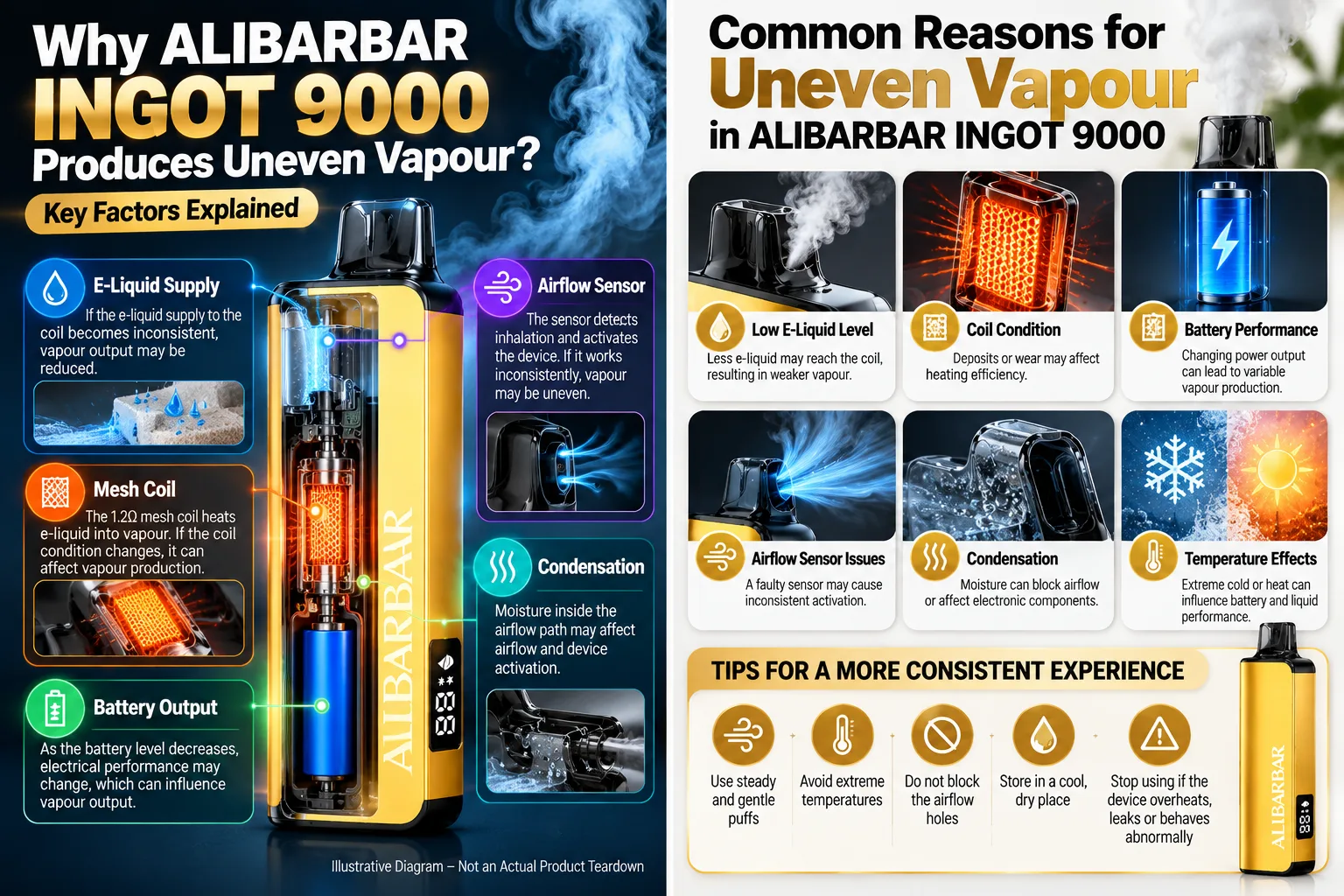
1. What Does Uneven Vapour Production Mean?
Uneven vapour production describes a situation where the amount of visible aerosol changes between activations.
For example, a device may produce a relatively large visible cloud during one activation and considerably less during another.
This can happen because of changes in how the heating element operates, how much e-liquid reaches the heated surface or whether the activation system responds consistently.
It is also important to distinguish aerosol production from visible cloud size.
Visible aerosol can be affected by environmental conditions such as temperature, humidity and airflow.
Therefore, a smaller visible cloud does not always establish that the device generated proportionally less aerosol.
2. Inconsistent E-Liquid Supply
One possible explanation is irregular liquid delivery.
Vaping devices require enough e-liquid to reach the heated region for aerosol to form.
Many vaping designs use absorbent material, commonly called a wick, to transport liquid towards the heating element.
Liquid movement through the wick may occur through capillary action.
If the heating region does not receive an adequate liquid supply, aerosol production may be reduced.
Possible contributing factors include:
Declining available e-liquid.
Changes in the distribution of liquid inside the device.
Disruption of the internal liquid-delivery pathway.
Damage or deterioration of absorbent material.
These are general engineering possibilities.
The exact internal liquid-delivery arrangement of an individual ALIBARBAR TEQ 12000 has not been independently verified here.
Does Uneven Vapour Mean the E-Liquid Is Almost Empty?
Not necessarily.
Low remaining liquid is one possible explanation, but it is not the only one.
Battery performance, activation faults and heating-system problems can produce similar symptoms.
A change in aerosol output alone cannot accurately determine the remaining e-liquid volume.
3. Can the Mesh Coil Affect Vapour Consistency?
The heating element is another important factor.
A mesh coil uses an electrically conductive mesh structure to generate heat.
When electrical energy passes through the element, heat is transferred to nearby liquid, allowing aerosol to form.
Mesh coil performance depends on several factors, including electrical power, liquid availability and the condition of the heating element.
Changes in any of these factors may affect aerosol production.
For example, insufficient liquid near a hot heating surface can disrupt normal aerosol formation.
Deposits or deterioration may also change heating behaviour over time.
However, inconsistent output does not automatically mean the mesh coil is damaged.
It is not possible to identify an internal coil fault from visible aerosol changes alone.
4. Battery Output and Electrical Performance
An electronic vaping device depends on a battery to supply electrical energy.
The battery works with internal control circuitry to power the heating element.
As a battery discharges, its electrical characteristics may change.
Depending on the design of the control circuitry, these changes can influence heating performance.
Some devices regulate the output to maintain a relatively consistent level until the battery reaches a cutoff condition.
Others may behave differently.
For this reason, reduced or uneven vapour should not automatically be attributed to low battery charge.
Can a Device Have Battery Power but Still Produce Little Vapour?
Yes.
Battery charge is only one requirement for aerosol production.
A device also needs an operational heating system, functioning activation circuitry and sufficient liquid delivery.
If any of these systems are affected, aerosol production may decrease even when electrical energy remains available.
5. Airflow Sensor Problems
Many disposable-style vaping devices use an automatic activation mechanism.
When a user inhales, a sensor detects a change in airflow or pressure.
The control system then activates the heating element.
If the sensor or its electrical connection behaves inconsistently, the heating system may fail to activate reliably.
Possible symptoms include:
Intermittent activation.
Unexpected changes in aerosol output.
Failure to activate.
Activation continuing after inhalation has stopped.
However, these symptoms can also arise from other electrical or mechanical faults.
They do not independently establish that the airflow sensor is defective.
If a device activates unexpectedly or continues heating when it should be inactive, stop using it.
Do not attempt to bypass or repair the activation system.
6. Can Condensation Affect Airflow?
Condensation can occur when aerosol cools and some of its constituents form liquid droplets on internal surfaces.
Small amounts of condensed material may collect near the mouthpiece or airflow passages.
In some circumstances, liquid accumulation may interfere with airflow or the activation mechanism.
However, not every sign of moisture is caused by condensation.
E-liquid leakage, damage to internal seals and other component faults may produce similar symptoms.
It is important not to assume that visible moisture is harmless.
If liquid is leaking from the device or the device behaves abnormally, stop using it.
Do not dismantle the casing or attempt to modify internal airflow components.
7. Does Puff Duration Affect Aerosol Output?
Puff duration can influence aerosol production.
A longer activation generally allows the heating element to operate for more time.
This may increase the total amount of aerosol generated during that activation, depending on available power and liquid supply.
However, two activations of the same duration may not necessarily produce identical amounts of aerosol.
Differences in device condition, electrical output and liquid delivery may also influence the result.
This helps explain why visible aerosol output can vary without establishing that a specific component has failed.
8. Does Temperature Affect ALIBARBAR TEQ 12000 Performance?
Temperature can influence battery-powered devices and the physical properties of liquids.
For example, cold conditions may affect battery output and liquid viscosity.
Excessive heat can contribute to battery degradation, leakage or other forms of damage.
These effects may influence normal operation.
However, it is not possible to determine the precise effect on a particular TEQ 12000 without testing the relevant device and operating conditions.
The device should not be exposed to excessive heat or left inside a hot vehicle.
Do not attempt to warm a vaping device using heaters, flames or other external heat sources.
9. Common Causes of Uneven Vapour: Comparison Table
Possible CauseHow It May Affect Aerosol ProductionReduced e-liquid supplyLess liquid may reach the heating elementInconsistent wickingLiquid delivery to the coil may fluctuateHeating-element deteriorationHeat transfer characteristics may changeBattery dischargeAvailable electrical output may changeControl circuit faultPower delivery may become inconsistentAirflow sensor problemActivation may become unreliableCondensation or leakageMoisture may affect airflow or electronic componentsTemperature exposureBattery and liquid properties may be affectedDifferent puff durationsHeating time and aerosol production may differThese are possible mechanisms, not confirmed TEQ 12000-specific failure rates or diagnoses.
10. When Does Uneven Vapour Become a Safety Concern?
A change in visible aerosol output is not enough to determine whether a device is hazardous.
However, certain symptoms require immediate attention.
Warning signs include:
Unexpected activation: The device operates when no inhalation is taking place.
Excessive heat: The body becomes unusually hot or continues heating when inactive.
Battery swelling: The enclosure becomes distorted or swollen.
Liquid leakage: E-liquid escapes from the device.
Smoke, hissing or unusual chemical odours: These may indicate a serious electrical or battery problem.
If any of these symptoms occur, stop using or charging the device.
Do not crush, puncture, open or attempt to repair it.
If the device is smoking, burning or creating an immediate danger, move away and contact emergency services.
In Australia, call 000 for an emergency.
11. What Should You Do When Vapour Output Becomes Inconsistent?
If a TEQ 12000 produces uneven aerosol, the safest approach is to avoid attempting internal repairs.
Follow these general precautions:
Check for visible external damage, swelling or leakage.
Stop using the device if it overheats or activates unexpectedly.
Consult the manufacturer's instructions for the exact device version.
Do not open the casing, adjust internal wiring or replace internal components.
Do not attempt to refill a sealed device.
If the device is no longer functioning, contact an appropriate electronic-waste or hazardous-waste service for disposal guidance.
Complete vaping devices should not be placed in ordinary household rubbish or kerbside recycling because of their integrated batteries and potential residual liquids.
12. What Australian Readers Should Know
Australia regulates vaping goods under a therapeutic vaping framework.
The commercial supply of single-use disposable vaping devices is prohibited.
Therapeutic vaping goods that meet the applicable requirements may be supplied through authorised pharmacy channels.
Australia also restricts advertising and promotion of vaping products.
The appearance of ALIBARBAR TEQ 12000 on an Australian-facing website does not establish that the product can legally be supplied in Australia.
Readers should consult the Therapeutic Goods Administration for current regulatory information.
Related reading
Uneven vapour is one of several end-of-life symptoms — the airflow troubleshooting guide covers the rest, and the ALIBARBAR TEQ range page is the place to compare a replacement if the device is simply finished.